
Top education options for a career in the Arts.
High paying art jobs and lucrative careers in art are available, if you know where to look!
By TACP Staff on July 07, 2021
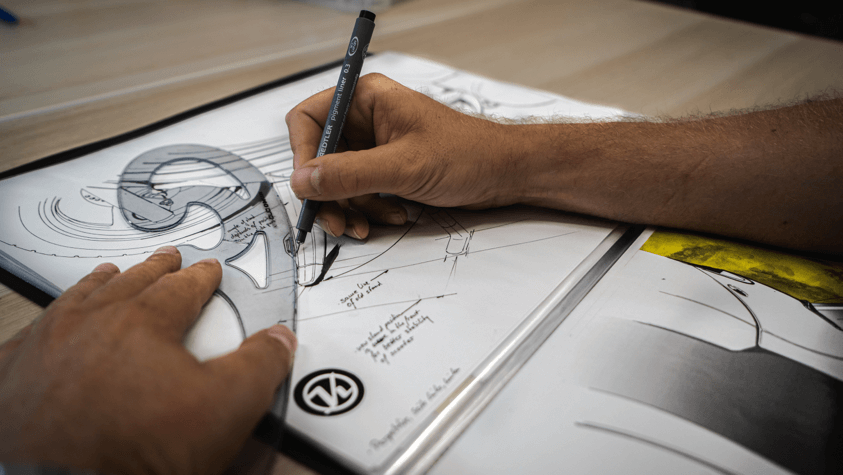
Industrial Design schools teach students about the professional practice of designing products, objects, services, and devices used by people throughout the world every day. Each object or device that you interact with on a daily basis at work, home, or school is the result of design decisions made by an industrial designer who sought to improve the appearance and functionality of the object through well-executed design.
Industrial designers create comfortable, attractive and functional products that people use everyday all around the world. They are directly involved with every step of that process, from initial idea to construction to final implementation.
Students who choose to pursue an industrial design degree can expect to take a series of design courses along with courses in history, psychology, and science. They will learn skills such as sketching, pattern making, product design, engineering CAD, and 3D modeling. Industrial design tends to be the most artistic of all engineering disciplines, while still requiring a strong technical background. New graduates who majored in this field will typically be hired into a position where they create designs for products that are manufactured and sold.
A bachelor’s degree in industrial design typically takes four years to complete and oftentimes includes courses like advanced CAD/CAM design, service-learning experiences, or internships with local companies. Students can choose from several different courses that will help prepare them for specific industries, including architecture and manufacturing. In addition, students learn about interior design as well as engineering principles.
A master’s degree in industrial design is a graduate degree that typically takes about two years to complete. It’s an advanced course of study for students who want to work in industries such as consumer product design, communications, and engineering. The curriculum may focus on subjects like materials science, human factors engineering, and 3D modeling. The master’s degree program will also prepare students for professional certifications such as the Industrial Designers Society of America (IDSA) certification.
Industrial design affects virtually every manufactured object on the planet. Its applications are ubiquitous – packages, containers, textiles, home furnishings, your mobile phone, and the chair you are sitting in are examples of industrial design. Yet, if you ask most people to define industrial design, no one seems to know what it is. The definition and differentiation are frequently confused and often vary depending on the context.
Perhaps this is because Industrial Design is a trans-disciplinary (relating to more than one branch of knowledge) profession that incorporates perspectives from several related fields and seamlessly balances the creative, conceptual, and technical thinking from several disciplines.
As a student of Industrial Design, you will build a well-rounded understanding of user behavior, shape, ergonomics, materials, color, finishes, manufacturing, and function. Outside of this core, you will also learn about how the benefits of an object or device can be communicated and how it sits within a brand. Your education will build upon several closely related disciplines, including the following:
User experience design is the process of enhancing customer satisfaction by improving the usability, accessibility, and pleasure provided in the interaction with a product. In more general terms, it is about creating a great experience for people who use (consume) a company’s products or services. User experience design is used in all disciplines involving designing products or services to understand how people interact with or experience them.
User interaction design is all about interactions between the user and the system. It’s used when designing any kind of interactive product but is especially important in designing software solutions. It’s about the aesthetics of an interface — how it looks and feels. Of course, your design won’t look or feel good unless it’s easy to use.
Graphic design is the process and practice of visual communication and presentation through the use of typography, photography, color, illustration, and layout. A graphic designer may use a combination of these techniques to produce a result that communicates messages or ideas visually. A graphic designer often uses images or illustrations to represent words and objects, which helps the viewer better understand a message.
Service design is the research, creativity, and thinking involved in designing new service experiences or improving existing ones. Every service has different expectations in terms of performance, security, reliability, and much more. A service designer will need to consider these expectations when creating the best possible experience for that individual customer segment. Service designers must know their customers’ needs intimately and be able to translate them into valuable, tangible, worthwhile service experiences.
Design research is a multidisciplinary field of design that focuses on qualitative research in order to better understand people, behaviors, and contextual factors of specific situations. Design research includes exploratory conversations, rapid prototyping and testing, participant observation, contextual inquiry, usability testing, and heuristic evaluation.
Typically design research is conducted in “context” which means that the focus of the design research is on a specific place or group of people. Design researchers will be side by side with their participants through their natural process to understand how they do things for themselves rather than watching them from afar.
Design strategy is the process of planning what creative direction a product will take. It is the process of understanding which customer segment to target and how to communicate with them in their language. As a result, design strategy creates products that will be unique to the target market and most likely stand out from other brands. This strategy often starts with creating personas and then determining what their needs, wants, motivations, values are so that you can create an experience targeted toward those needs.
Branding and marketing are terms that often go hand in hand. Branding is the process of creating a visible and meaningful association between a product and its company. Marketing is the process through which consumers are informed about the products and services offered by a company, usually by using words, images, pricing, promotions, and sales tactics.
At its basic level, engineering is the application of science to the challenges of product design and manufacturing. Product engineering is at the intersection of these two areas, where a company or institution develops a product that meets its specifications and needs. Industrial design is critical to bringing the engineering side to life. Industrial design translates the plans, drawings, and specifications created by an engineer into a tangible, physical product that can be manufactured.
A degree in Industrial Design can change the trajectory of your career. And, while selecting a school can start to feel like an overwhelming process, it is important to keep in mind that your education should not only prepare you for your professional education, but also for your life beyond school. Industrial Design schools can differ greatly in terms of size, location, and focus, but what they should share is a dedication to providing students with a comprehensive education. This list ranks the best industrial design schools in the United States according to five criteria: degree program strength, faculty members and their commitment to student success, percentage of students enrolled in graduate programs, admission requirements, and cost of attendance.
| RANK | SCHOOL | LOCATION |
|---|---|---|
| 1 | Rhode Island School of Design | Providence, RI |
| 2 | Carnegie Mellon University | Pittsburgh, PA |
| 3 | ArtCenter College of Design | Pasadena, CA |
| 4 | California College of the Arts | San Francisco, CA |
| 5 | Pratt Institute | New York, NY |
| 6 | Savannah College of Art & Design | Savannah, GA |
| 7 | Rochester Institute of Technology | Rochester, NY |
| 8 | University of Washington | Seattle, WA |
| 9 | Drexel University | Philadelphia, PA |
| 10 | Ohio State University | Columbus, OH |
| 11 | Brigham Young University | Provo, UT |
| 12 | College for Creative Studies | Detroit, MI |
| 13 | School of the Art Institute of Chicago | Chicago, IL |
| 14 | University of Illinois | Champaign, IL |
| 15 | Iowa State University | Ames, IA |
| 16 | Auburn University | Auburn, AL |
| 17 | Cranbrook Academy of Art | Bloomfield Hills, MI |
| 18 | Georgia Tech | Atlanta, GA |
| 19 | Arizona State University | Tempe, AZ |
| 20 | San Francisco State University | San Francisco, CA |
The Art Career Project is a trusted resource for emerging and professional artists.